A new study published in the Journal of Sustainable Agriculture and Environment examined how different tillage methods (moldboard plough, vertical/chisel tillage, and no‑tillage) and the use of manure influence soil organic matter, carbon content, and crop yields on working farms in the U.S. Midwest. The research found that crop rotations with mixed forage and hayfields supported higher soil carbon and organic matter compared to continuously cultivated fields, and that positive correlations exist between soil organic matter and corn yield. Incorporating manure helped mitigate soil carbon loss from tillage, though best management practices remain important for long‑term soil and environmental health. This on‑farm research was supported in part by The Herbert W. Hoover Foundation.
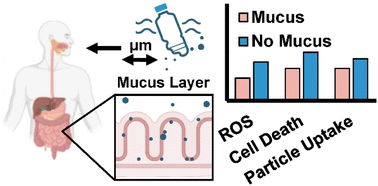
With support from The Herbert W. Hoover Foundation, researchers at Cornell University published new findings in Biomaterials Science showing that human intestinal mucus plays a critical role in blocking microplastics from entering gut tissue. The study revealed that an intact mucus barrier significantly reduces cellular uptake, inflammation, and oxidative stress caused by plastic particles ranging from 40 to 500 nm. Particle size, surface chemistry, and composition all influenced how easily plastics migrated through the barrier. These results deepen our understanding of how microplastics affect human health and highlight the importance of gut integrity in protecting against environmental pollutants. The full article is available here.
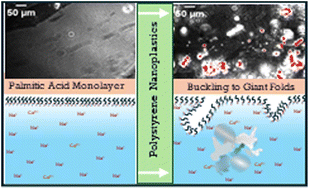
A recent study published in Environmental Science: Atmospheres revealed that nanoplastics — tiny particles from degraded ocean plastics — can disrupt fatty-acid films at the ocean’s surface, which play a key role in how gases and particles move between the ocean and the atmosphere. These changes may affect the formation and behavior of sea spray aerosols, which influence cloud formation and climate processes. The research highlights a new potential pathway for plastic pollution to impact our climate. This paper was funded in part by The Herbert W. Hoover Foundation and featured on the issue cover of Environmental Science: Atmospheres.
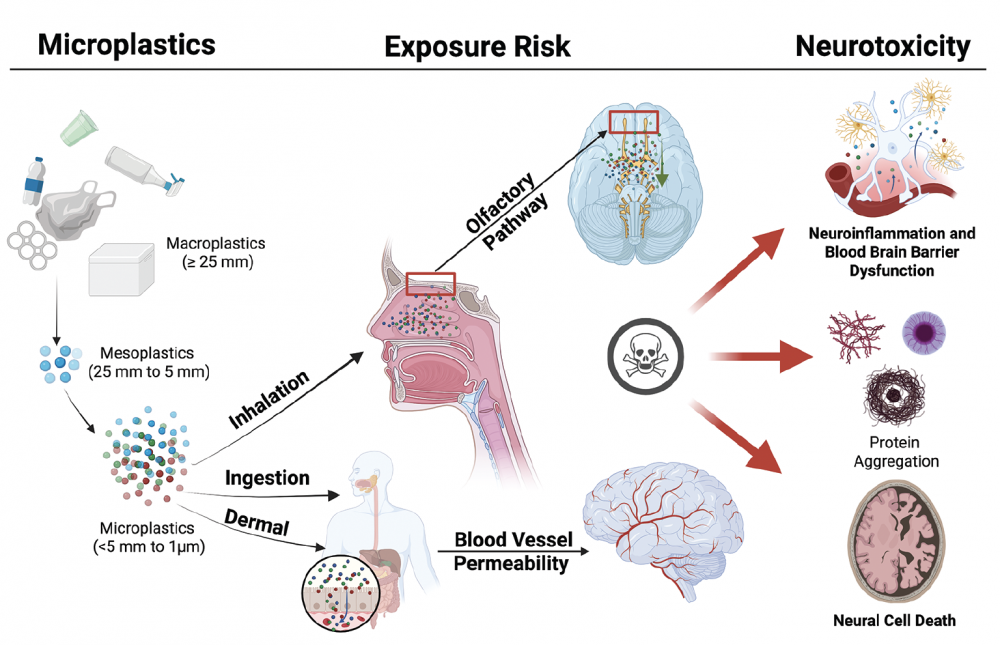
Funded by the Herbert W. Hoover Foundation, a recent review in Practical Neurology examines emerging evidence that microplastics – tiny fragments from degraded or single‑use plastics – can enter and accumulate in the human brain, potentially contributing to neurodegenerative and cerebrovascular illnesses such as dementia, Parkinson’s disease, and stroke.
The authors describe multiple pathways through which microplastics may reach the brain — including inhalation (via the olfactory nerve), ingestion (via the gut–brain axis), or direct passage through a compromised blood–brain barrier.
Once within the brain, microplastics may trigger harmful effects such as oxidative stress, neuroinflammation, disruption of neurotransmitter systems, and aggregation of disease‑associated proteins like amyloid‑β and α‑synuclein.
The article calls attention to significant research gaps — especially around dose, exposure route, and long-term impacts — and advocates reducing exposure to plastics as the most practical step for now. Read the full review here.
We use cookies to enhance your experience while using our website. If you are using our Services via a browser you can restrict, block or remove cookies through your web browser settings. We also use content and scripts from third parties that may use tracking technologies. You can selectively provide your consent below to allow such third party embeds. For complete information about the cookies we use, data we collect and how we process them, please check our Privacy Policy